
Crypto portfolio tracking has evolved well beyond the days of basic balance checkers. Something that was once a hobbyist tool for early adopters has evolved to become a primary requirement for serious investors handling multi-chain, multi-platform portfolios. By the year 2025, the best platforms no longer differentiate themselves based on design or number of integrations – they differentiate based on accuracy, automation, and veracity.
In this review, we’ll get a complete overview of the heavy-hitters shaping this sector – from old-school analytics dashboards to institutional-level systems. It’s not about crowning a “winner” in the classical sense, but to see why certain sites now seem indispensable, and others are temporary.
Introduction: The Year Portfolio Tools Became Strategic
The 2025 crypto market does not anymore incentivize guessing. Volatility, taxation, and convoluted cross-chain systems have compelled investors to reassess how they monitor, evaluate, and reposition portfolios. Sitemap tools are no longer afterthought utilities – they have become strategic blockers for decision-making and compliance.
How portfolio management transformed from basic apps to data-driven systems
In the earlier days, crypto tracking apps functioned as paper notebooks: entry-by-hand, snapshot-of-balance, and static chart. As time went by, it became obsolete. With thousands of tokens, many networks, and yield-oriented investing, investors started demanding automation – systems which don’t just record but also decipher.
Up-to-date portfolio services now handle real-time feeds from centralized exchanges (CEX), decentralized finance (DeFi) sites, NFT exchanges, and even old-fashioned banks. Real-time evaluations, profit-and-loss reports, and predictive insights that make data to advice are handled. Algorithmic reconciliation replaced the old-fashioned manual reconciliation.
It wasn’t a case of making it fast – making it clear. Investors desired assurance that what appeared on the screen reflected the reality of their assets sitting in various wallets and blockchains.
Why investors in 2025 are asking for seamlessness, integration, and automation
By 2025, the typical cryptocurrency investor has juggling many platforms: a trading platform, a staking platform, an NFT platform, and occasionally a tokenized real estate or equity platform. With no automation, this quickly gets out of control.
Today’s leading services must handle:
- Multi-chain tracking – from Ethereum to Solana and Layer 2 networks.
- Synchronization of exchanges – frequent data pulls that show actual ROI/PnL, not balance point in time snaps.
- Compliance and tax reporting – enforced automatically against jurisdictional compliance.
- UpTime and security – non-custodial design supplemented with encryption and sound infrastructure.
Investors no longer demand performance near peer-to-peer-grade efficiency. Downtime or inaccurate data isn’t a hassle anymore – it’s a liability. It’s quick liability for platforms that don’t deliver accuracy. As another user poll for 2025 succinctly stated, “We don’t just want to see numbers – we want to believe them.”
Defining what “best” actually means in a tracking- and analytically-rich ecosystem
With so many tracking programs that call themselves “the most accurate,” the definition of best has become fluid. For serious professionals, it may mean integration depth, clear visualization of ROI calculations, and reliable sync performance. For hobby investors, it’s ease of use – a dashboard that’s both intuitively accessible and believable.
In this comparison, we’ll evaluate each primary service along these primary dimensions:
| Evaluation Factor | What It Will Mean in 2025 | Why It Matters |
| Data Validity | Correct ROI, PnL, and cost basis across chains | Prevents false profit assumptions |
| Automation | Real-time sync and reconciliation | Saves time, deletes human error |
| Firewalls | Non-custodial data processing, secure APIs | Shields sensitive keys and portfolios |
| End-Users as People | Logical structure, responsive design | Facilitates adoption among both newcomers and old-timers |
| Scope of Integrations | Coverage of CEX, DeFi, NFTs, and banks | Reflects portfolio overall health |
1. CoinDataFlow
https://coindataflow.com/en/portfolio-tracker
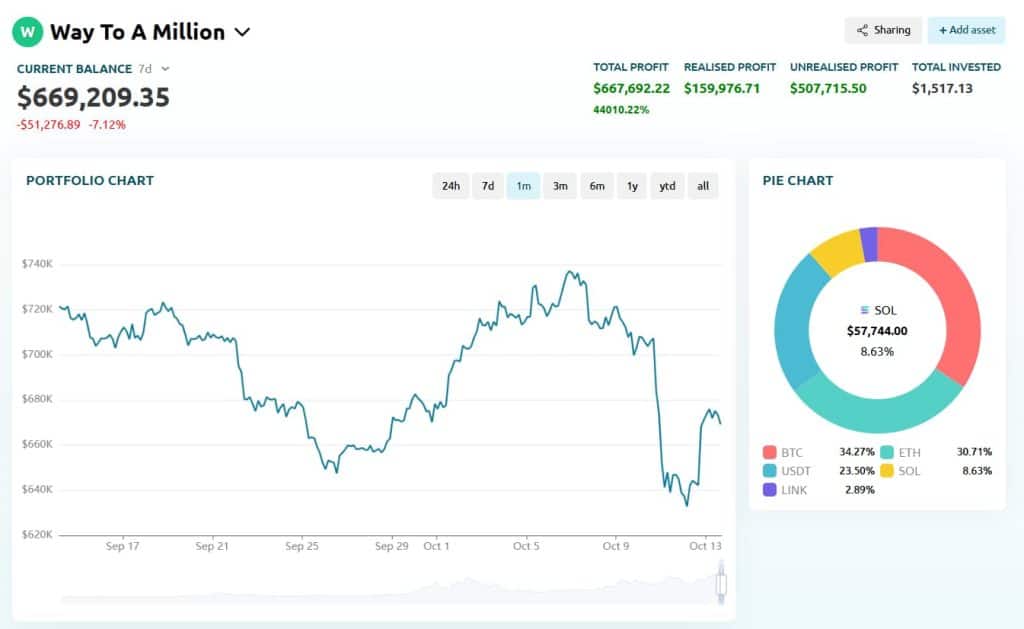
With portfolio tracking developing as a strategic imperative, certain platforms shifted faster than others. CoinDataFlow became among the few that achieved to blend pure analytics and real-world usability – building a set of tools appropriate both for daily investors and professionals handling sophisticated, cross-platform holdings.
Integrated architecture: aggregator and portfolio analytics under a single roof
While most rivals bezel in solely focusing on a single aspect – either tracking or analytics – CoinDataFlow does both together in a single environment. CoinDataFlow brings together real-time data from the primary centralized exchanges, DeFi protocols, NFT markets, and even tokenized conventional assets. By allowing both to coexist, CoinDataFlow enables the user to see the complete set of their possessions without shifting between apps or importing a CSV file.
It flows continuously, grabbing changes in prices and balance in real time. It minimizes human input and the lag that tends to dog other trackers.
For users who have many exchange accounts and many wallets, the experience is smooth – a single login, a single dashboard, complete insight.
One significant aspect is the backend clarity: CoinDataFlow publicly discloses its data sources, informing users how numbers are derived. It has also allowed it to gain credibility among investors, who want quantifiable metrics that are not just “aggregated data.”
| **Feature | Description | Value for Investor** |
| Live Data Sync | Real-time tracking of wallets, CEXs, DeFi | Prevents deprecated or out-of-sync values |
| Unified Dashboard | All your assets in one place | Reduces daily portfolio tracking |
| Data Source Transparency | Unclouding of APIs and price feeds | Establishes credibility of accuracy |
| Cross-Market Analytics | DeFi + CEX + NFT data together | Provides a complete picture of wealth |
Strengths: correct ROI/PnL, quick sync, clarity of data sources
It has remained a primary factor behind CoinDataFlow’s escalation in 2025 that its ROI and PnL metrics are in sync with real-time market data, despite volatility. It updates dynamic and realized profits based on transaction charges and historical cost basis.
For day traders, this accuracy translates to sound decision-making. For long-term holders, it provides a clear understanding of real growth – not speculative value.
Rapid synchronization infrastructure supports the platform. Portfolio updates remain responsive even when networks are congested or prices spike. Since other tools are based on slow, delayed hourly refreshes, CoinDataFlow provides near-instant mirroring of trades and transfers.
It’s also nice to see how the numbers are being calculated. Every measure has a “source breakdown,” which indicates if it’s coming from a direct exchange API, blockchain scan, or user input. That transparency makes analytics something that can be proven – not merely graphical.
Weaknesses: little automation beyond analytics (for the moment)
Where CoinDataFlow still has potential to mature is in automation beyond reporting. Though data sync and calculations are automated, trading and sophisticated portfolio rebalancing – both capabilities found in more trader-oriented programs – are left on the roadmap and not yet in production.
This is a deliberate decision: the firm appears happier to be correct and reliable than to dive headfirst into automation. Nonetheless, some heavy users would like to have integrated smart orders or trigger alerts based on PnL thresholds.
Why its balance of accessibility and professional analytics makes sense in 2025
CoinDataFlow’s appeal in 2025 has nothing to do with being ostentatious – it has to do with tasteful balance. Its UI makes sophisticated data understandable without drowning the user, and its analytics deliver institutional-level insight sans institutional education.
It ends up being a platform that performs as well for a person checking prices at lunchtime as it does for a professional handling multi-million portfolios across exchanges.
It does not promise to supplant every niche tool, but it does a good job anchoring a portfolio – providing users with a foundation of clarity, precision, and transparency that other services tend to build around, not equal.
2. CryptoCompare
https://www.cryptocompare.com/portfolio
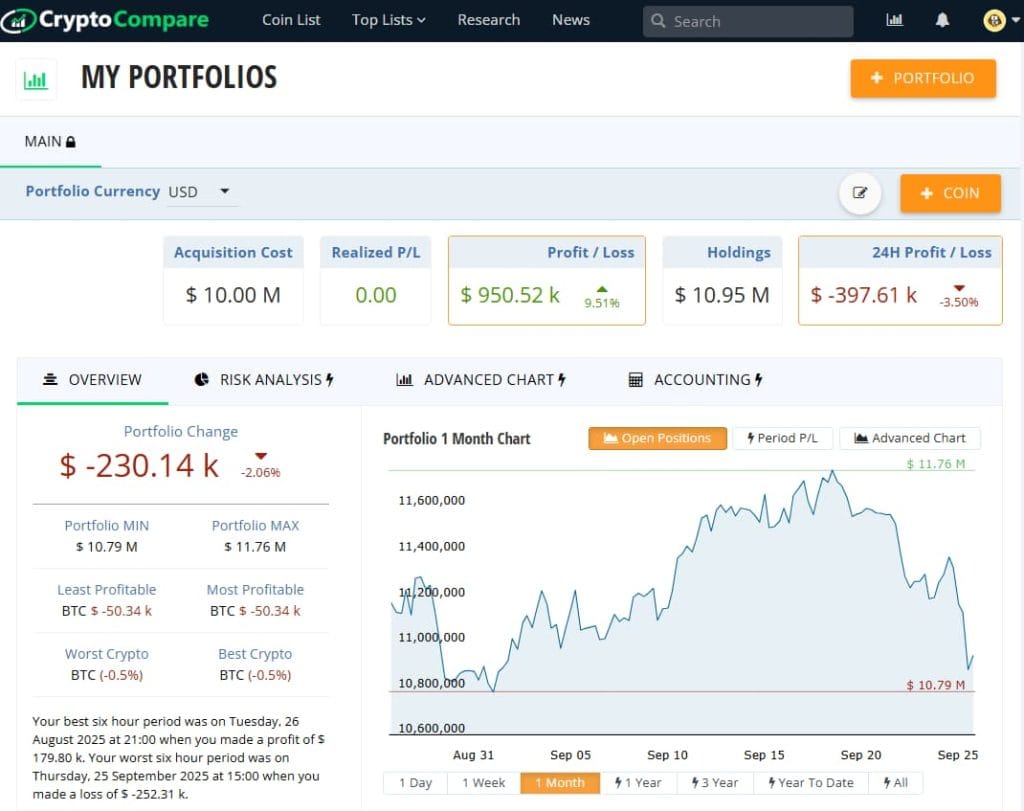
CryptoCompare is an old and familiar name when it comes to the world of crypto analysis. It was once famous just for its market data and price feeds, but it branched out to provide portfolio tracking to account-holders who desired a comfortable environment for managing their own holdings. Its long-standing presence makes it a default entry point for beginners, but professionals tend to leave it behind as their demands become more sophisticated.
Well-established trustworthiness and hassle-free onboarding
Due to its heritage as a data provider, CryptoCompare enjoys instant name recognition. Investors often encounter its charts and indices on external websites before realizing it also provides a portfolio tracker. Signing up is quick and simple: users can either import wallet data manually or connect to exchanges via limited API integration.
Once connected, the dashboard displays essential metrics such as balance, percentage change, and asset distribution. An integrated market feed adds news and price updates, giving even casual investors a constant sense of awareness.
| **Feature | Description | Benefit** |
| Fast Setup | Connects wallets and exchanges in minutes | Low barrier for beginners |
| Market Integration | Built-in price charts and indices | Real-time context without extra tools |
| Multi-Portfolio Support | Allows individual portfolio views | Great for testing different strategies |
| News Feed | Crypto headlines alongside performance data | Keeps users updated in one interface |
This accessibility explains why CryptoCompare continues to be a frequent starting point for those entering crypto investing. It strikes a balance – professional enough to be credible yet simple enough to use without any training.
Interface simplicity for beginners
Aesthetically, the dashboard favors clarity over complexity. It uses large fonts, clean charts, and straightforward navigation tabs. Investors can quickly review their portfolio composition, value trends, and allocation percentages.
For users managing a small number of assets, the interface feels welcoming rather than intimidating. The addition of color-coded visuals and plain labels helps make it easier to understand.
In usability studies, many beginners expressed appreciation that they “always know where to click.” That sense of control helps them transition from basic wallet apps to more analytical tools without friction.
Weaknesses in automation and data granularity
Where CryptoCompare struggles is in moving beyond simplicity. Automated data reconciliation is minimal, which means that transactions across multiple chains or smaller exchanges might not sync accurately. Users often need to manually fix totals or fill in missing trades.
More advanced needs – such as per-transaction cost basis, regional tax calculations, or complex DeFi income tracking – are mostly unsupported.
For active traders or diversified investors, this gap becomes more noticeable over time. While basic analytics exist, they feel static compared to more dynamic, data-rich platforms. Professionals usually migrate to systems with higher granularity, continuous synchronization, and automated cross-platform calculations once they move past the “beginner” stage.
As one 2025 user put it:
“It’s good to get started, but when you’re juggling multiple networks, it’s like having a calculator when you really need a full accounting system.”
In short, CryptoCompare’s strength lies in familiarity and simplicity – qualities that make it inviting also limit its usefulness for serious, long-term investors.
3. CoinStats
https://coinstats.app/portfolio
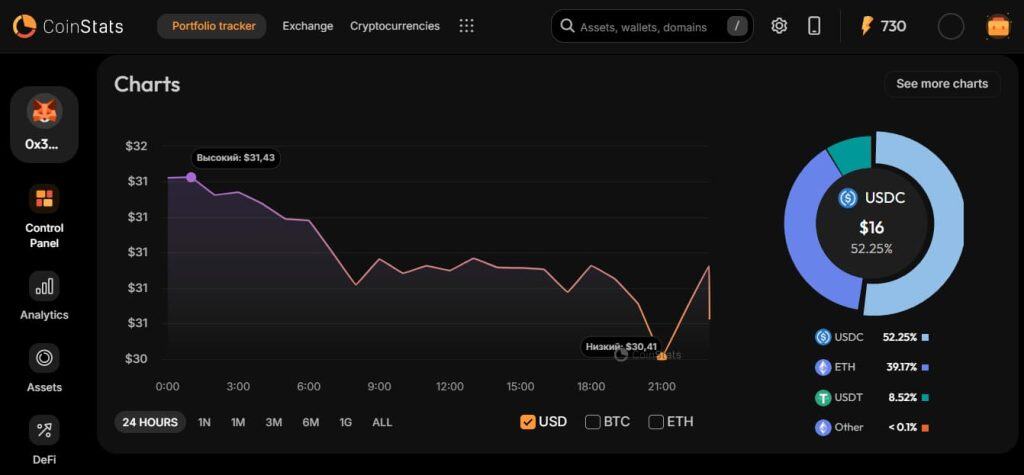
CoinStats has become one of the most recognizable multi-platform portfolio managers, balancing integrations, alerts, and trading utilities within a single ecosystem. By 2025, it caters to both retail and semi-professional users who value breadth – the ability to connect nearly every wallet or exchange they use – even if that sometimes sacrifices clarity for volume.
Widely integrated and intelligent alerts
CoinStats integrates with more than 300 exchanges and thousands of tokens, spanning centralized exchanges and DeFi wallets. The app supports both API syncing and wallet scanning, giving users real-time updates across multiple blockchains without repetitive manual input.
Another standout feature is its alert system. CoinStats provides instant notifications for price movements, portfolio fluctuations, and staking reward distributions. This transforms it from a passive viewer into an active assistant that enables users to react quickly to volatility or opportunities.
For example, when Bitcoin passes a set threshold or a DeFi token surges unexpectedly, the app sends real-time alerts that help users respond immediately. For regular traders or those experimenting with yield strategies, this feature saves time and prevents missed opportunities.
| **Feature | Description | Investor Value** |
| Integrations | Over 300 CEXs, wallets, and DeFi platforms | Centralizes all holdings |
| Notifications | Price, balance, and reward alerts | Helps detect market changes early |
| Portfolio Charts | Allocation and profit visuals | Makes data easier to interpret |
| Multi-Device Sync | Same data across desktop and mobile | Ensures consistent access across environments |
This level of integration makes CoinStats particularly appealing for users managing diverse portfolios. It reduces fragmentation and gives investors a sense of centralized control.
Advanced tools for active traders
CoinStats also offers premium features tailored to advanced users. Paid tiers include historical analytics, automatic tax reporting, and API-based export functions compatible with accounting software.
Active traders can create customizable dashboards displaying ROI, realized gains, and strategy-based sub-portfolios.
The app’s trading interface – available in select regions – connects directly to exchanges via secure APIs, allowing users to trade without leaving the app. This positions CoinStats midway between a portfolio tracker and a lightweight trading terminal.
However, its pricing model may discourage casual investors. Many professional-grade tools are locked behind subscriptions, and the free version often limits how many exchanges or portfolios can be connected.
Occasional complexity and overemphasis on premium features
While CoinStats delivers extensive functionality, its mobile and desktop interfaces can feel cluttered. Too many widgets and overlapping data panels create visual noise. New users often describe it as “data overload,” particularly when diving into advanced analytics.
This complexity, combined with aggressive upselling toward paid tiers, can frustrate users who simply want to monitor performance without unlocking additional features.
Certain screens also load slowly when handling multi-chain assets, and some API connections require periodic reconfirmation.
Still, for those who appreciate flexibility and don’t mind navigating a dense interface, CoinStats remains a powerful option – especially for users who prioritize notifications and wide-ranging integrations.
It embodies the modern “Swiss Army knife” philosophy: capable of many tasks at once, though sometimes less elegant than specialized tools.
4. CoinTracking
https://cointracking.info/crypto-portfolio-tracker
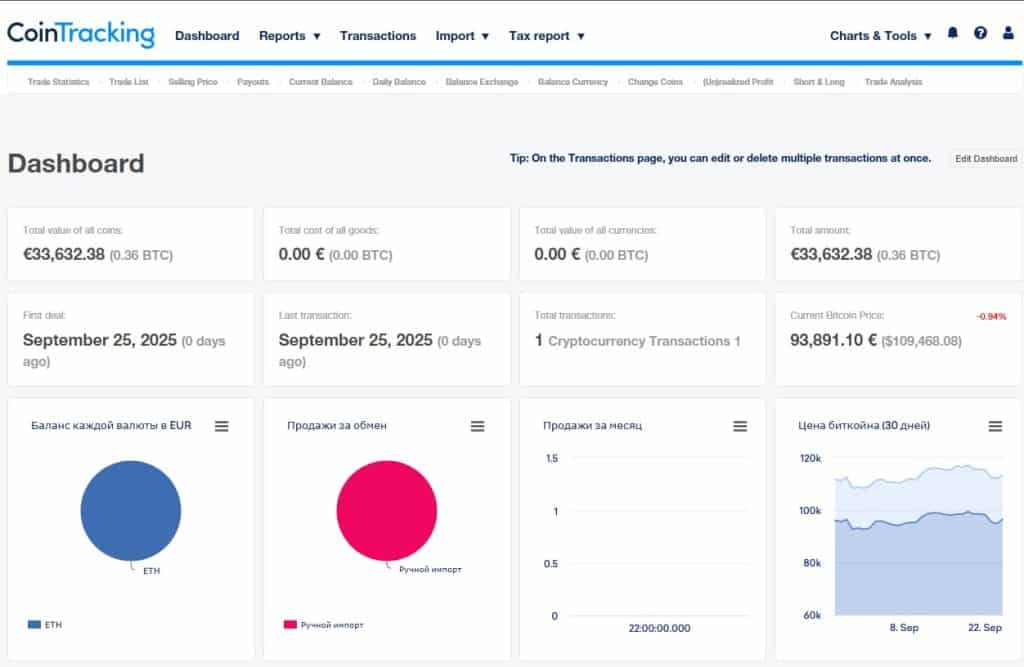
CoinTracking has built a reputation for its meticulous reporting and tax compliance tools. While most modern trackers emphasize minimalistic visuals, this platform takes an accounting-first approach to portfolio management. For data-driven investors, its focus on accuracy and record-keeping makes it one of the most technically comprehensive tools available – though not the easiest to use.
Historical data depth and tax-ready reporting
CoinTracking’s biggest strength lies in its historical tracking capabilities. Users can import years of trade data from exchanges, CSVs, or APIs, creating a fully auditable record of their crypto activity. Each transaction is logged with timestamp, price, and fee details, enabling precise cost-basis calculation – essential for accurate profit and loss reporting.
The platform also includes built-in tax modules customized for key jurisdictions such as the U.S., U.K., Germany, and Australia. Users can generate tax summaries, FIFO/LIFO breakdowns, and capital gains reports with minimal manual work. For accountants or investors managing multiple portfolios, this consistency and accuracy are invaluable.
| **Feature | Description | User Benefit** |
| Historical Import | Supports CSV and API trade history | Enables multi-year tracking |
| Tax Calculation | Built-in regional templates | Simplifies annual reporting |
| Detailed Analytics | Trade-level and cost-basis views | Provides forensic-level accuracy |
| Audit Support | Exportable tax and trade logs | Aids in compliance verification |
CoinTracking feels less like a standard “portfolio app” and more like a financial control center. For users who value traceability and accountability, it offers unmatched visibility into every fund movement.
Ideal for detailed analysis and compliance
Professionals, accountants, and institutional investors favor CoinTracking for its ability to reconcile thousands of transactions with minimal errors. Its analytics modules go beyond simple ROI to include realized/unrealized gains, asset correlations, and fully customizable reports.
This focus on granularity helps investors answer questions other tools can’t – such as which strategies performed best over multiple cycles or how transaction fees impacted profitability. It’s a platform designed for those who prefer to audit themselves before regulators ever need to.
For firms managing client portfolios or dealing with compliance, CoinTracking’s ability to export standardized reports (PDF, Excel, XML) is another key advantage.
Heavy UX and costly for smaller investors
However, the same features that make CoinTracking powerful can also make it intimidating. The interface, though detailed, feels outdated compared to newer dashboards. Menus are dense, charts functional but not polished, and navigation requires patience and familiarity.
Small investors may also find it expensive. The free plan is very limited, and paid tiers – particularly for those importing large datasets – can cost several hundred dollars per year.
The mobile experience also lags behind competitors, with fewer real-time features and slower syncing. It’s clear that CoinTracking’s strength lies in structured, accurate data, not in day-to-day convenience.
Still, for users who value precision over simplicity, CoinTracking remains unmatched. It’s a tool built for those who treat crypto management like a financial audit – not just a casual glance at market prices.
5. Zerion
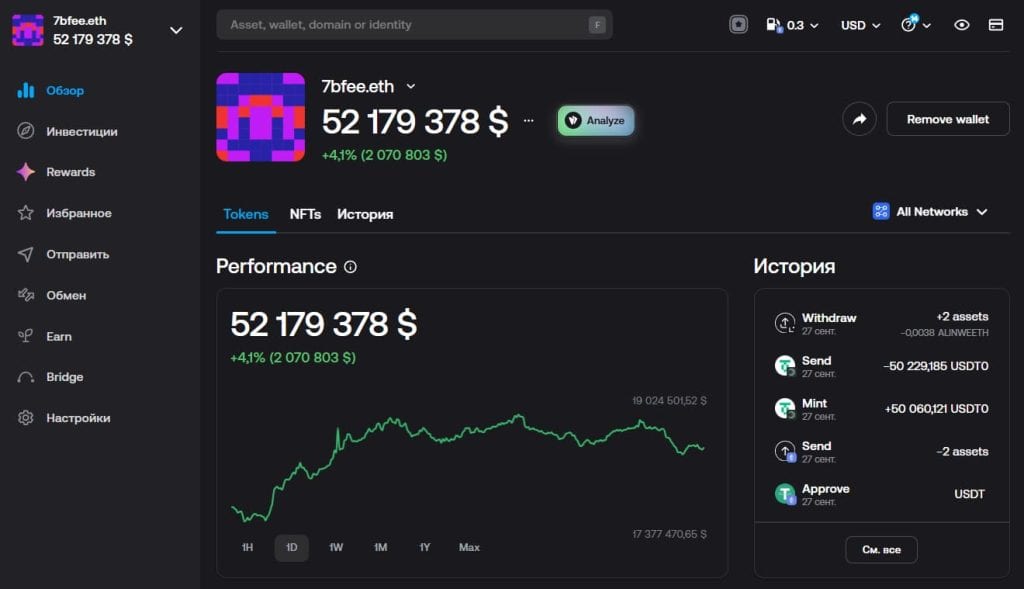
Zerion arose during the DeFi boom as a wallet-based portfolio manager built around on-chain data. Unlike older dashboards that rely mainly on exchange APIs, Zerion emphasizes blockchain-level transparency, giving users direct insight into wallet activity, token positions, and NFT collections. By 2025, it remains one of the most refined DeFi-focused portfolio platforms – especially for users who value self-custody.
DeFi-focused tracker with a modern design
The first thing users notice about Zerion is its clean, visually engaging interface designed for Web3 activity. Instead of dense tables and text-heavy menus, it presents holdings as modular cards, each displaying token performance, liquidity pool exposure, and yield activity. This makes the experience intuitive, even when handling complex DeFi protocols.
Zerion automatically detects wallet assets across major chains such as Ethereum, Polygon, Arbitrum, and Avalanche. Users can see the value of staked tokens, NFT holdings, and pending rewards in real time. For those deeply involved in decentralized finance, this eliminates the need for manual entries or third-party import tools.
| **Feature | Description | Value for DeFi Users** |
| Multi-Chain Visibility | Tracks assets across EVM-compatible networks | Consolidates fragmented portfolios |
| Wallet Sync | Connects via MetaMask, Ledger, or WalletConnect | Enables fast and secure onboarding |
| Yield Tracking | Displays DeFi positions and rewards | Simplifies income monitoring |
| NFT Integration | Shows collectibles alongside tokens | Unifies all asset categories |
Zerion’s design philosophy revolves around transparency: users can verify every number directly on-chain. That reliability is a major reason the DeFi community continues to trust it.
Wallet-level transparency and NFT visualization
Zerion excels at visualizing blockchain activity. Each wallet functions as both a data source and a performance tracker. When users interact with DeFi protocols like Aave or Uniswap, Zerion updates their positions automatically – no extra setup required.
The same applies to NFTs. The platform integrates floor prices and collection performance metrics, displaying digital collectibles in the same view as financial assets. This unified approach appeals to users who treat NFTs as part of their overall investment strategy.
Another standout feature is transaction visualization: every on-chain action – from swaps to staking deposits – appears as an event timeline. For many DeFi investors, this replaces the need for separate blockchain explorers.
Narrow focus on DeFi portfolios
While Zerion’s DeFi integration is best-in-class, its specialization comes with limitations. Centralized exchange accounts (like Binance or Coinbase) require manual input or external aggregation, forcing users with mixed portfolios to use multiple tools.
Additionally, Zerion’s analytics focus on wallet-level yield and exposure tracking rather than traditional PnL or tax metrics. Investors seeking regional tax compliance or fiat-based reporting will need complementary software.
Even though the mobile app is sleek, it can feel crowded when tracking multiple networks simultaneously. As portfolio size grows, real-time updates sometimes lag – a tradeoff for processing live on-chain data.
Still, Zerion remains a leader for users whose crypto activity centers around Web3 ecosystems. It excels at giving investors a transparent, verifiable view of their decentralized holdings – even if its centralized coverage still has room to improve.
6. Nansen Portfolio
https://www.nansen.ai/crypto-portfolio-tracker
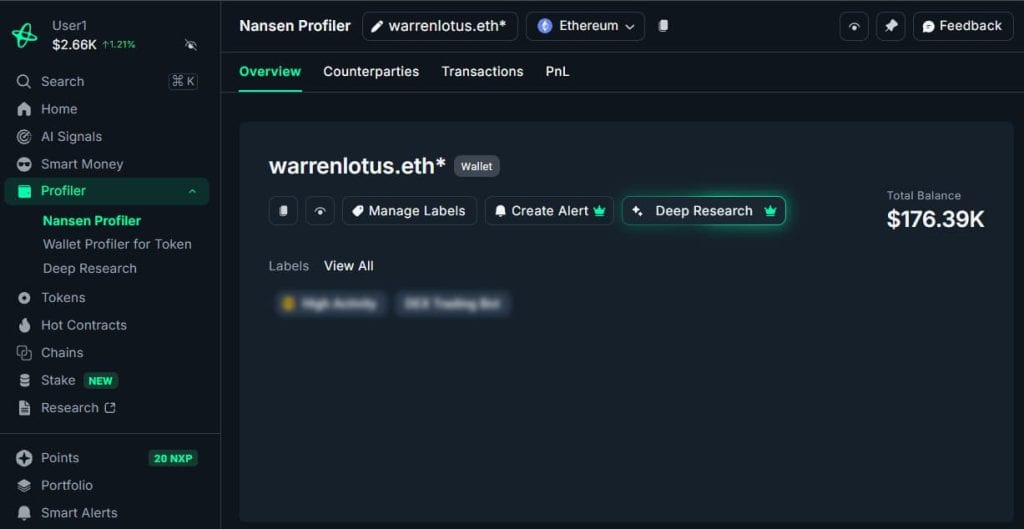
Nansen Portfolio expands the well-known Nansen analytics platform into a comprehensive portfolio management system. Built on its on-chain intelligence infrastructure, the platform bridges the gap between blockchain analytics and investor dashboards. By 2025, Nansen Portfolio stands out as a premium solution for professionals who want to combine wallet tracking with deep behavioral insights derived from blockchain data.
On-chain analytics and smart wallet insights
What sets Nansen Portfolio apart from traditional portfolio trackers is its use of proprietary on-chain analytics. Rather than simply showing balances, it interprets blockchain activity. Users can identify which wallets are accumulating specific tokens, follow capital flows across multiple networks, and even benchmark their portfolios against institutional or “smart money” wallets.
This data-driven approach turns basic monitoring into deep analysis. Traders can detect early signs of market sentiment shifts – for instance, by observing large wallets moving stablecoins onto exchanges or accumulating governance tokens.
| **Feature | Description | Value for Advanced Users** |
| Smart Money Tracking | Monitors high-performing wallets | Identifies emerging market trends |
| Portfolio Comparison | Benchmarks against top performers | Provides strategic context |
| Cross-Chain Data | Unified visibility across multiple chains | Simplifies portfolio allocation |
| DeFi Protocol Mapping | Displays exposure across protocols | Helps optimize yield strategies |
The dashboard allows investors to customize their analytical layers, toggling between ROI, token movement, and risk exposure metrics – all presented in dynamic real-time charts.
Excellent for professional and institutional users
Nansen Portfolio is particularly attractive to fund managers, research teams, and algorithmic traders. Its built-in segmentation tools enable users to group assets by chain, project type, or wallet label – supporting complex analyses that few other platforms can match.
For institutional users, the compliance and research integrations are a major advantage. Nansen’s KYC-aligned modules and audit-ready reporting formats help large organizations ensure regulatory compliance while maintaining transparency.
Research departments also benefit from the platform’s extensive data. Many firms use Nansen’s aggregated insights to evaluate token performance, liquidity distribution, and governance participation – analyses that go far beyond typical portfolio tracking.
For example, a research analyst might study how DAO treasury movements correlate with token price changes, using Nansen’s “entity labeling” to visualize connections between protocols.
Cost and complexity limit mass adoption
Despite its power, Nansen Portfolio is priced well above what most retail users can afford. Subscription tiers target professionals, with some plans exceeding several hundred dollars per month. Free users get limited access to historical data and a narrow selection of portfolio metrics.
The platform’s sophistication also creates a barrier. While the interface is sleek, interpreting its analytics requires experience with blockchain behavior, making it less intuitive for beginners.
Additionally, its focus on wallet-level analysis leaves gaps in exchange-based activity. Retail investors who trade mainly on centralized exchanges may find its coverage incomplete.
Still, for institutional desks and data-driven individuals, Nansen Portfolio delivers insights that no traditional tracker can match. It doesn’t just show performance – it explains it through blockchain behavior.
7. Copper
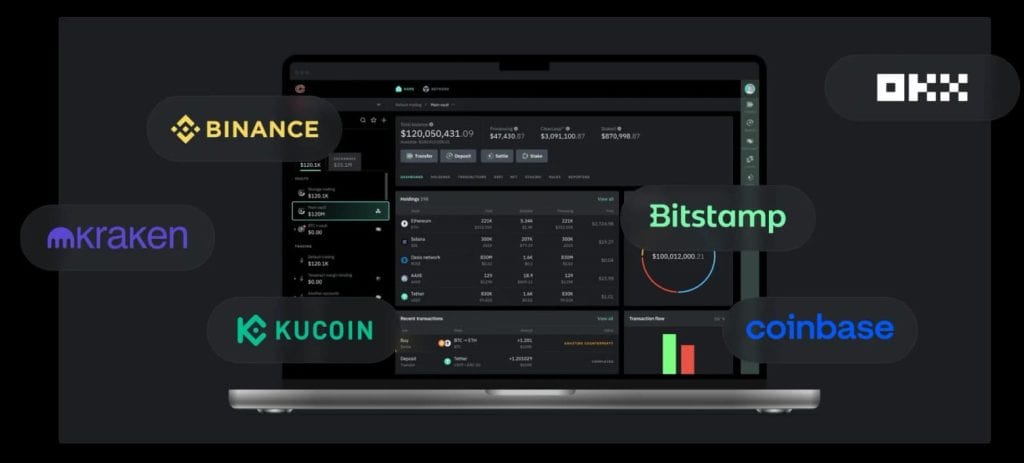
Copper occupies the upper tier of crypto portfolio systems, catering primarily to institutional investors who prioritize compliance, custody, and operational control. Unlike retail-focused dashboards that emphasize interface aesthetics or mobile convenience, Copper offers an enterprise-grade architecture that integrates asset tracking, auditing, and security infrastructure – setting the benchmark for what “institutional-grade” means in crypto management by 2025.
Institutional-quality custody and compliance capabilities
Copper is built around its ClearLoop network – a secure system linking exchanges, custodians, and trading venues without requiring funds to leave cold storage. This structure minimizes counterparty risk while preserving full trade execution capabilities, a major attraction for hedge funds, family offices, and professional asset managers.
Copper’s dashboards focus less on colorful ROI charts and more on compliance assurance. Users receive audit-ready transaction logs, segregated client accounts, and customizable reports aligned with major regulatory frameworks such as MiCA (EU) and SEC standards (US).
| **Feature | Description | Benefit for Institutions** |
| ClearLoop Integration | Executes trades without transferring assets | Reduces counterparty risk |
| Compliance Reporting | Automated audits and KYC reports | Simplifies oversight for institutions |
| Custody Security | Multi-signature cold storage | Strengthens client asset protection |
| Custom Permissions | Granular access controls | Supports multi-department operations |
Copper transforms crypto portfolio management into a regulated financial workflow. For firms managing client assets, this level of structure ensures precise accountability and minimizes operational risk across every stage.
High-level automation and auditing functionality
Copper’s automation extends far beyond standard tracking. The platform includes smart reconciliation for fund accounting, automated NAV (Net Asset Value) updates, and integrations with back-office tools like Bloomberg Terminal and Refinitiv.
This allows compliance teams and fund accountants to align crypto exposure with broader financial reports – a rare instance where blockchain-based assets integrate seamlessly into traditional audit environments.
Copper’s data visualization tools, though less flashy than consumer apps, are highly precise. Reports can be filtered by counterparty, transaction type, or jurisdiction, offering detailed oversight of capital movement. For institutional treasurers, the dashboard doubles as a real-time risk management tool, displaying liquidity and exposure levels across venues.
Out of reach for retail users due to cost and complexity
While Copper excels in institutional contexts, it remains inaccessible to most individuals. Its pricing structure targets corporate clients, with onboarding fees and annual commitments designed for funds managing millions in assets.
For everyday investors, the platform feels overbuilt. Its workflow assumes knowledge of compliance procedures and fund operations, while the focus on cold storage management holds little relevance for users trading modest amounts.
There’s also no mobile app, a deliberate decision to preserve security and administrative control.
In essence, Copper represents the farthest end of the professional spectrum – a fortress of compliance rather than a convenience app. For institutions, it’s indispensable. For individual investors, it’s simply beyond practical use.
What the Comparison Reveals
After reviewing the top portfolio platforms of 2025, one clear truth stands out: the best solution depends entirely on the investor’s context. Each service embodies a different philosophy – from Copper’s institutional-grade compliance to Zerion’s decentralized openness – yet they all pursue the same goal: simplifying how users understand and control their digital wealth.
Best practices among leading players – accuracy, automation, and trust
Across the industry, three defining traits separate the top performers: data accuracy, automation, and trustworthiness.
- Data Accuracy:
Nearly every platform now understands that mistakes in ROI or PnL calculations can destroy credibility. Tools like CoinTracking and Nansen Portfolio emphasize granular trade histories and precise cost-basis tracking, proving that investors want verified data, not rough estimates. - Automation:
Manual data entry is essentially obsolete in 2025. From API syncing to real-time blockchain scanning, automation has become the standard. Platforms that still rely on manual uploads or adjustments – such as older versions of CryptoCompare or CoinTracking’s free plan – feel outdated next to fully automated systems. - Trust:
With users linking exchanges, wallets, and DeFi platforms, security and data integrity now dictate adoption. The platforms that have invested in non-custodial frameworks and encryption transparency have gained the most traction, while those requesting excessive permissions quickly lose credibility.
| **Core Principle | Importance in 2025 | Example Platforms Excelling** |
| Accuracy | Ensures confidence in ROI/PnL metrics | CoinTracking, Nansen Portfolio |
| Automation | Saves time and reduces user error | Zerion, CoinStats |
| Trust & Security | Builds long-term user confidence | Copper, DeBank |
As institutional and retail expectations converge, investors now expect professional-grade reliability – even from free tools.
Why user experience still determines adoption
Despite the rise in sophistication, usability remains the deciding factor for mass adoption. Platforms overloaded with analytics – like Coin Market Manager or CoinTracking – risk alienating users who simply want to see balances and profits without wading through complex dashboards.
Conversely, overly simplified tools often frustrate power users who require deeper performance insights or tax-ready exports. This contrast highlights a core paradox of modern crypto software: the easier it becomes, the less control it offers; the more control it offers, the less approachable it feels.
What users now expect is balance – a system that shows everything clearly, without clutter. As a result, mid-tier professional dashboards that stay intuitive often outperform both minimal and overcomplicated options.
As one Reddit reviewer summed it up in early 2025:
“It’s not about how many features the tracker has – it’s about whether I can actually use them without reading a manual.”
The balance between accessibility and professional analytics matters most
The ideal portfolio tool of 2025 achieves clarity without compromise. It delivers advanced analytics and transparent ROI insights in a format approachable enough for semi-professional and informed retail investors alike.
Institutional-grade platforms like Copper set the bar for compliance but remain overbuilt for individuals. On the other hand, minimalistic trackers like Coin.fyi or CryptoCompare are great for beginners but quickly feel limited as portfolios grow more complex.
The most successful tools occupy the middle ground – blending automation, accuracy, and accessible analytics. Investors are tired of juggling multiple dashboards for different asset types. The true winners in 2025 are those that finally unify DeFi, CeFi, and NFT portfolios under a single, seamless interface.
FAQ
Which crypto portfolio manager provides the best estimate of ROI/PnL in 2025?
Precision now depends on how effectively a platform combines real-time market data with historical trade records. Platforms like CoinTracking and Nansen Portfolio offer transaction-level tracking, reaching near audit-grade accuracy in PnL. However, many semi-professional dashboards have narrowed the gap by introducing multi-source data verification. For everyday investors, tools that automatically reconcile exchange and wallet data with minimal manual input remain the most reliable.
Is it safe to connect exchanges and wallets?
Security largely depends on the platform’s design. Non-custodial dashboards, where users retain control of their private keys, remain the safest option. They use encrypted, read-only API connections that never allow withdrawals. On the institutional side, platforms such as Copper enhance protection further through segregated accounts and multi-signature systems, reducing counterparty risk.
Always check permission scopes before linking any account and favor apps that clearly outline their encryption standards.
Are free tools reliable for active investors?
Free trackers generally work well for beginners but tend to limit automation and historical coverage. Apps like CryptoCompare or Coin.fyi provide simple interfaces but depend on manual updates. Once portfolios span multiple exchanges or include staking and DeFi positions, free tiers quickly hit their limits. Paid or professional-grade services are usually necessary for complete accuracy and long-term analytics, especially for tax or audit preparation.
| Tier | Typical Features | Suitable For | Limitations |
| Free | Manual entry, limited API sync | Beginners | Missing tax or multi-chain tracking |
| Mid-tier | Automated imports, mobile app, ROI/PnL | Active users | Partial analytics access |
| Premium | Full integrations, tax-ready reports, audit support | Professionals | Subscription cost |
Which platforms combine tax tools with real-time analytics?
Only a few achieve both. CoinTracking and Blockpit specialize in tax reporting but can feel heavy for everyday portfolio use. Recently, some hybrid dashboards have emerged, merging these capabilities into lightweight, real-time systems that let users generate tax-ready PnL directly from live data.
The key differentiator is automation – whether the platform can convert every trade, reward, and fee into compliant, timestamped records without manual reconciliation.
Do institutional dashboards make sense for individuals?
Typically, no. Enterprise-grade tools like Copper or Talos are built for hedge funds, custodians, and asset managers operating under legal and reporting frameworks. Their workflows and pricing are overkill for retail traders.
Instead, individuals benefit more from consumer-oriented dashboards that replicate institutional reliability – with encryption, real-time syncing, and audit logs – but without the complexity or cost.
What defines the true “leader” among trackers in 2025?
The best crypto portfolio tracker in 2025 isn’t the one with the most features – it’s the one that finds the right balance between automation, clarity, and security. Investors now look for platforms that deliver:
- Consistent, verifiable ROI/PnL reporting
- Smooth multi-exchange and cross-chain synchronization
- Transparent privacy and encryption policies
- Adaptable UI that works seamlessly across devices
A true leader offers professional reliability in a user-friendly format – something investors can depend on every day without friction.
Conclusion
By 2025, crypto portfolio tracking has evolved from basic calculators into sophisticated, interconnected ecosystems. The platforms now leading the space are those that treat portfolio management not as an add-on, but as a vital bridge between user control, automation, and compliance.
CoinDataFlow’s rise to industry leadership reflects this evolution. Instead of competing through hype or aggressive monetization, it succeeded by focusing on the investor’s fundamental need – to see, trust, and understand their digital assets with clarity and ease.
Where the market goes next
Looking beyond 2025, the boundaries between tracking, trading, and wealth management will continue to fade. Artificial intelligence will increasingly influence the field – from predictive rebalancing to sentiment-driven alerts – while regulation will push platforms toward transparent, finance-grade reporting standards.
As investors seek both autonomy and oversight, the winners will be platforms that combine the openness of DeFi with the stability of fintech infrastructure.
In essence, the era of speculative dashboards is over. The future belongs to transparent, data-driven systems like CoinDataFlow – tools built not just to display assets, but to define how digital wealth is intelligently managed.